
Sound Engineering at Human Head Studios
Katherine Stull
01 / 31 / 18
‹ Back to Blog
It’s important to us that our games look and feel great, but they need to sound great too! Human Head Studios has a recording studio where we create our audio in-house. The recording studio is run by Jun Soo Noh, our sound engineer. With nearly 10 years of audio experience, he is responsible for digitally processing and creating all of the sound effects for our games. We talked to him about his process and some of the crazy ways that he creates immersive audio for video games.
One method for creating sound effects is with the use of audio software. Jun primarily works in Pro Tools to process sounds, but also uses Reaktor, iZotope, and Matlab. He pulls up a video file of the cutscene or trailer that he’s designing audio for, and implements digital sound and music at the right moments so it lines up perfectly. This is done by mixing the tracks and sounds together, blending them, and adjusting the length and pitch. While working digitally, Jun recommends wearing a good set of headphones. Many gamers wear headphones while playing games, and it’s important that the audio sounds good through gaming headsets.
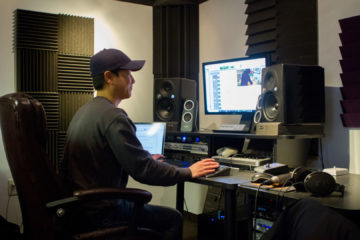
Another method by which Jun creates sound effects is through the use of foley. Foley effects are sound effects that are added in post-production. They often are created by reproducing realistic sounds with everyday objects. For example, Jun will crackle a plastic bag to simulate rustling, or he will record his voice for monster sounds. Sometimes he needs to get creative in order to make the perfect sound - he once used a large (real) sword from our studio display to create sword impact noises!
Regardless of the method he chooses, Jun has an established workflow. First, he tries to imagine the end-goal of what the effect will sound like. He then researches the desired sound and finds resources that may be helpful in reproducing it. He processes the sound with software tools before passing it on to the game programmers to be implemented. With their skills combined, Jun and the developers can make the soundscape of each game immersive and realistic.
Jun’s advice for those looking to experiment with audio design is to pay attention to the sounds you hear in everyday life and media. He believes that the perfect sound could come from any number of unconventional sources. The software that Jun uses can be demoed for free, but there are many other resources available for beginners as well.
For more ideas on how to get started in game development, check out the list of programs in our Beginner’s Toolkit!
